

Playing for the planet
How serious games and escape rooms can spark teamwork and community engagement for climate action?
1. Introduction
Climate change is not just a scientific challenge, it is a social one. The success of climate action depends on how well communities can cooperate and act together toward shared goals. Yet fostering that kind of collaboration can be difficult.
In recent years, serious games and escape rooms have emerged as innovative tools for engaging people in complex social and environmental problems. Unlike traditional learning formats, these experiences invite participants to play with possible futures, explore consequences, negotiate trade-offs, and build shared understanding. They do not just teach facts, they nurture teamwork, empathy, and civic agency, key components of social and civic competence.
When applied to climate issues, these playful spaces can help people connect global crises with local realities, transforming abstract fears into shared challenges.
2. Why Games and Escape Rooms Fit Climate Engagement
Serious games and escape rooms are built on experiential learning and social interaction. They require participants to communicate, divide roles, make decisions, and problem-solve together under time pressure, all elements that mirror the cooperative and systemic nature of climate action.
Indeed, recent studies indicate that serious games and escape rooms are not merely entertaining novelties, they are structured social experiences in which participants practice the very skills needed for community-based climate action: collaboration, communication, and collective problem-solving. Ouariachi and Wim (2020) examined a variety of climate-themed escape rooms and found that immersive storytelling, limited time, and collective puzzle-solving foster both motivation and deeper understanding of climate processes. Similarly, González-Muñoz et al. (2022) developed an Educational Escape Room on Energy and Climate Change (EER) and demonstrated that collaborative gameplay increased engagement, comprehension of energy-transition issues, and willingness to discuss real-world solutions. More recently, Repetto et al. (2024) analyzed digital escape rooms for sustainability learning and concluded that online collaboration can extend access to diverse participants while maintaining the social and motivational benefits of in-person teamwork.
3. Mechanisms by Which Games Foster Climate Engagement
When designed thoughtfully, serious games and escape rooms can activate several mechanisms that bridge the gap between awareness and action, such as:
Collective negotiation.
Players must discuss trade-offs, allocate resources, and agree on strategies. This practice of cooperative decision-making strengthens civic dialogue and empathy.
Role-taking and perspective shift.
By assigning participants roles such as citizen, policymaker, or entrepreneur, games allow people to experience different constraints and motivations, promoting systems thinking, essential for addressing shared environmental problems.
Feedback awareness.
Games visualize the effects of decisions within minutes, compressing time to reveal long-term consequences. Participants see how inaction or miscoordination worsens outcomes, internalizing lessons that data alone rarely convey.
Emotional engagement.
Escape rooms heighten urgency and narrative immersion (i.e. “you have 60 minutes to save the city from a flood”), reinforcing a sense of agency.
4. Practical examples: 2 Games That Turn Climate Concern into Collective Action
1. Unlock the Future: The Environmental Escape Game

Developed by Katarzyna Pater (2020), Unlock the Future combines sustainability science, psychology, and storytelling in a cooperative escape game. Players solve interlinked puzzles representing planetary boundaries and possible ecological futures.
The design promotes systems thinking: each solved puzzle restores an “Earth system,” but progress requires cross-team cooperation, reflecting the interconnectedness of real climate challenges. Evaluations show that participants leave with greater confidence in their ability to act and a clearer sense of environmental interdependence.
Beyond its educational value, Unlock the Future demonstrates how escape-room mechanics (limited time, shared risk, and collective discovery) can transform climate discourse into an emotionally resonant team experience.
2. I-CHANGE Project: “Our Climate Story”
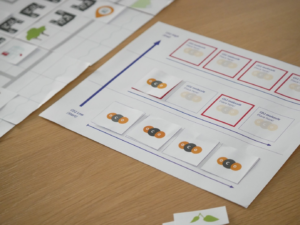
At a civic scale, the I-CHANGE Project advances serious gaming even further. Its digital platform, Our Climate Story, enables citizens to explore how everyday behaviors contribute to emissions and to co-design solutions within their own cities.
Unlike purely educational tools, Our Climate Story links gameplay to real-world data and community initiatives. Players visualize their carbon footprints, compare scenarios, and commit to concrete actions, turning the game into a participatory laboratory for behavioral change.
Workshops involving schools, NGOs, and municipalities create a bridge between play and policy: participants become co-authors of local climate narratives, discovering pathways to collective transformation.
Together, these examples illustrate the spectrum of climate-action games—from immersive storytelling that fosters awareness (Unlock the Future) to participatory digital ecosystems that translate engagement into tangible community outcomes (Our Climate Story).
5. Conclusion
Ultimately, serious games and escape rooms offer something traditional communication often lacks: shared experience and agency. When people play together to “save the planet,” they rehearse the collaboration and solidarity required beyond the game.
To unlock their full potential for climate action, communities can:
- Integrate such games into local awareness campaigns, citizen assemblies, or school programs.
- Use post-game debriefs to connect participants with ongoing projects or municipal climate plans.
- Adopt “train-the-trainer” models so facilitators can adapt games for their own neighborhoods.
In a global crisis that can feel paralyzing, play may seem trivial, yet play is how humans learn to cooperate, imagine alternatives, and act together. Serious games and escape rooms transform climate change from an overwhelming abstraction into a shared, manageable challenge.
When communities play for the planet, they also learn to plan for the planet.
References
González-Muñoz, C., Muñoz-Moreno, J., Iglesias-Pradas, S., & Hernández-García, Á. (2022). Educational escape room on energy and climate change (EER): Enhancing engagement and learning through gamified collaboration. Electronic Journal of e-Learning, 20(5), 422–434. https://academic-publishing.org/index.php/ejel/article/download/3186/2295/10072
I-CHANGE Project. (2023). Our Climate Story: A serious game for civic climate engagement. MAIA Project Knowledge Base. https://maia-project.eu/knowledge-base/i-change-project-launches-serious-climate-change-game
Ouariachi, T., & Wim, L. (2020). Escape rooms as tools for climate change education: An exploration of initiatives. Retrieved from ResearchGate. https://www.researchgate.net/publication/340791601_Escape_rooms_as_tools_for_climate_change_education_an_exploration_of_initiatives
Pater, K. (2020). Unlock the Future: A transdisciplinary environmental escape game. Uppsala University. https://www.diva-portal.org/smash/get/diva2%3A1514256/FULLTEXT01.pdf
Repetto, M., Sáez-López, J. M., & Pérez-García, A. (2024). Digital educational escape rooms for sustainability learning. Sustainability, 16(19), 8525. https://www.mdpi.com/2071-1050/16/19/8525